
Growing up, I attended every Ash Wednesday like any other faithful Catholic child. It’s not like there was much of a choice — munhu wese aienda kuchurch. It was routine for me: Ash Wednesday, Lent, then Easter.
I sang the song “Yeuka Munhu,” received my ashes, shared the “from dust to dust” post, and it all felt normal because everyone I knew was doing it. I also went to a Catholic boarding school, so I never really thought much about it.
It wasn’t until my first year at university that something shifted.
This time, I went for morning Mass instead of the usual evening one, received my ashes, and then headed off to class. As I walked down the road, I noticed people staring at me like I was some kind of alien. I couldn’t understand why.
It wasn’t until I walked into class that it hit me — it was the ashes on my forehead.
I immediately became aware of my surroundings and realized I was the only one with ashes (most people who got them got them in the evening). I felt strange. Something I had done my entire life suddenly felt awkward.
For a moment, I thought about wiping them off.
But then I felt guilty. And a little stubborn too.
Instead, I began to wonder: Why do I actually get these ashes? If someone had asked me then, I honestly would have just said, “Yeuka munhu uri huruva.” Full stop.
That moment sparked something in me.
It gave me a zeal to understand my faith more deeply — to understand why the Church has this practice and why I had chosen to participate in it. I began researching. At first, I just wanted an answer in case someone questioned me. But the more I learned, the more I realized this was not just a tradition.
It was something deeper. Something transforming.
I’ll share what I’ve found, and I hope it helps you too.
What is Ash Wednesday?
Ash Wednesday is the first day of Lent, the Church’s sacred season of preparation for Easter. It is not merely a date on the liturgical calendar; it is a deliberate pause — a moment to confront our humanity, our sinfulness, and our need for God. We receive ashes as a sign of repentance and begin 40 days (+ 6 Sundays) of preparing our hearts for Easter.
The words proclaimed on this day echo the call of Christ:
“…repent and believe in the Gospel.” — Mark 1:15
It is the doorway into transformation. Repentance is not about staying in guilt and shame. It is about returning to God and experiencing His mercy.
Why Ashes?
The placing of ashes on the forehead is one of the most striking gestures in the Church’s liturgy. Ashes remind us that we are mortal — that life is fragile and temporary. They confront us with truth: we are dust, and to dust we shall return.
Yet ashes are not a sign of despair. In Scripture, they symbolize humility and repentance:
Daniel prayed in ashes (Book of Daniel 9:3).
Nineveh repented in ashes (Book of Jonah 3:6).
“Return to me with all your heart, with fasting, with weeping, and with mourning.” — Joel 2:12
They represent an outward expression of an inward desire to change.
Where Do the Ashes Come From?
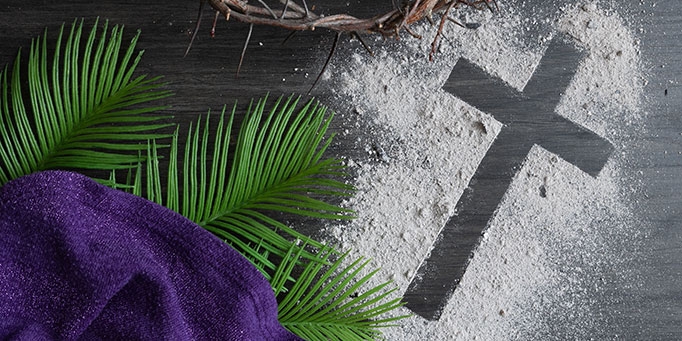
The ashes imposed on Ash Wednesday are traditionally made from the blessed palm branches of the previous Palm Sunday. After being burned, the ashes are blessed and used as a sacramental sign.
The same palms once raised in celebration of Christ’s triumphal entry into Jerusalem are transformed into ashes placed on our foreheads.
Praise becomes humility.
Celebration becomes reflection.
The Church teaches that faith is not only about shouting “Hosanna,” but also about returning to God with sincerity of heart.
So, how do we observe Ash Wednesday?
The day is a day of both fasting and abstinence from meat for Catholics, a universal day of penance.
Fasting reduces the quantity of food we consume.
Abstinence removes a common comfort — meat — as an act of sacrifice.
These practices are not random rules. They are spiritual disciplines. They teach detachment and self-control.
Above all, Catholics are encouraged to attend Mass because Ash Wednesday is rooted in worship, not symbolism alone.
As the Psalmist prays:
“Create in me a clean heart, O God, and put a new and right spirit within me.” – Psalm 51:10
The goal is inner transformation.
Why does it matter?
Ash Wednesday does not magically change anyone. It offers an opportunity.
The ashes will fade. The mark disappears. But the question remains: will the heart change?
This day stands at the threshold of Lent — an invitation to walk deliberately toward Easter, toward renewal, toward resurrection.
So who can get the ashes?
Anyone may receive ashes. They are not a sacrament but a sacramental sign — a public symbol of reflection and repentance.
Catholics, non-Catholics, those strong in faith, and those still searching — all may come forward.
Ash Wednesday is the doorway.
What lies beyond depends on how we respond.